


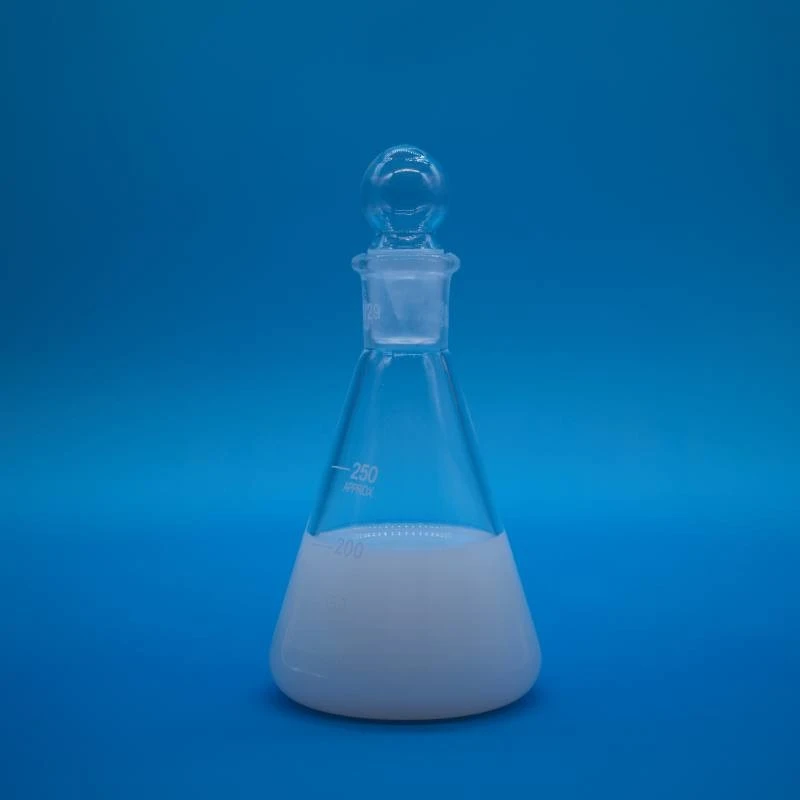
Shandong Peak-tech New Material Co., Ltd. is one of the most reliable manufacturers and suppliers of silica sol for chemical mechanical polishing in China. With a professional production team, we are able to meet the needs of the majority of our customers. Welcome to buy durable silica sol for chemical mechanical polishing for sale here from our factory.
Silica Sol for Chemical Mechanical Polishing
| Model | Particle Size | SiO₂ Content | Metal Ions | pH | Shelf Life |
|---|---|---|---|---|---|
| HP25D10 | 10–20 nm | 25±1% | <20 ppm | 7–9 | ≥12 months |
| HP3010 | 10–20 nm | 30±1% | <50 ppm | 7–9 | ≥12 months |
| HP2510A | 10–20 nm | 21–25% | <50 ppm | 2–4 | ≥12 months |
| HP4010A | 10–20 nm | 38–42% | <50 ppm | 2–4 | ≥12 months |
Aluminum present as Al₂O₃ is excluded from the listed metal-ion total. These HP grades are abrasive-dispersion candidates, not finished CMP slurry specifications. Final approval requires element-specific analysis and process trials.
Choose the Grade Around the CMP Chemistry
The appropriate silica sol depends on the polished film, slurry pH, chemical additives, removal-rate target and defect budget. Nominal particle size alone is not sufficient for CMP qualification.
HP25D10
Provides the tightest published total metal-ion limit, 25±1% SiO₂, NH₄⁺ stabilization and a pH range of 7–9.
HP3010
A near-neutral candidate with 10–20 nm particles and a published total metal-ion limit below 50 ppm.
HP2510A
An acidic candidate containing 21–25% SiO₂ for slurry systems whose chemical window requires lower pH.
HP4010A
A higher-solids acidic option for controlled dilution and formulation development under compatible CMP chemistry.
CMP Data Required Before Grade Recommendation
- Polished material: identify the target film or substrate, underlying layers and required selectivity.
- Slurry chemistry: provide target pH, oxidizer, complexant, inhibitor, surfactant and permitted ionic species.
- Particle controls: define primary size, PSD, oversized-particle limit, agglomerate limit, filtration and measurement method.
- Contamination limits: state maximum values for sodium, iron, aluminum and other controlled elements with analytical methods.
- Polishing targets: provide removal rate, selectivity, uniformity, surface roughness, scratch and particle-defect limits.
- Process conditions: include tool type, pad, pressure, speed, flow rate, endpoint strategy and post-CMP cleaning.
Qualify Purity, Stability and Defectivity
Incoming Analysis
Confirm solids, pH, particle distribution and element-specific impurities using agreed sampling and analytical methods.
Slurry Stability
Evaluate dilution behavior, zeta-potential direction, additive compatibility, agglomeration and filtration under the intended chemistry.
Polishing Performance
Measure removal rate, selectivity and within-wafer or within-substrate non-uniformity under controlled tool conditions.
Surface Quality
Inspect roughness, scratches, particles, pits and other substrate-specific defects after polishing and cleaning.
Request a CMP Silica Sol Grade
Send the substrate, slurry chemistry, particle specification, elemental limits, removal targets, defect criteria and trial quantity.
Request CMP Qualification SupportProtect High-Purity Dispersion Quality
Packaging Review
Available polyethylene packaging sizes are 25 kg, 250 kg and 1000 kg. Confirm clean-packaging requirements before ordering.
Storage Temperature
Store at 0–40°C and prevent freezing. Temperatures below 0°C can cause irreversible gelation.
Contamination Control
Keep transfer equipment and containers clean and compatible with the required elemental contamination limits.
Container Closure
Keep containers closed to reduce evaporation, foreign-particle entry and precipitation of solid silica particles.
Silica Sol for Chemical Mechanical Polishing FAQ
Which silica-sol grades can be evaluated for CMP?
The published high-purity candidates are HP25D10, HP3010, HP2510A and HP4010A.
Which grade has the lowest published metal-ion total?
HP25D10 is listed below 20 ppm. The other three HP grades are listed below 50 ppm.
Are these products finished CMP slurries?
No. They are silica-sol abrasive candidates for formulation development. Oxidizers, complexants, inhibitors and other slurry components must be selected for the target process.
Why are element-specific limits still needed?
A total metal value does not show the concentration of each critical contaminant. CMP buyers should specify individual elements, methods, detection limits and reporting basis.
What polishing results should be validated?
Validate removal rate, selectivity, uniformity, roughness, scratches, residual particles and other process-specific defects.
Hot Tags: silica sol for chemical mechanical polishing, China silica sol for chemical mechanical polishing manufacturers, suppliers, factory
Applications of Silica Sol for Chemical Mechanical Polishing
HP silica-sol grades can be evaluated as abrasive candidates in CMP and precision-polishing formulations. Each application requires control of slurry chemistry, particles, impurities, removal performance and defects.
Semiconductor Wafer CMP
High-purity grades can be screened where particle control, elemental contamination and low defectivity are critical.
Oxide and Dielectric CMP
Candidate grades may be evaluated after matching slurry pH, chemistry, removal rate and selectivity to the film stack.
Compound Semiconductor CMP
Trials can assess substrate-specific removal, surface roughness, scratches and post-polish particle defects.
Electronic Ceramic Polishing
Controlled nanosilica can be qualified for compatible ceramic substrates requiring fine surface finishing.
Precision Glass Polishing
Selected grades can be tested in compatible glass and display-finishing systems with defined contamination limits.
Custom CMP Slurry Development
Supports formulation work requiring selected pH, solids, metal limits, particle metrology, filtration and clean handling.


