


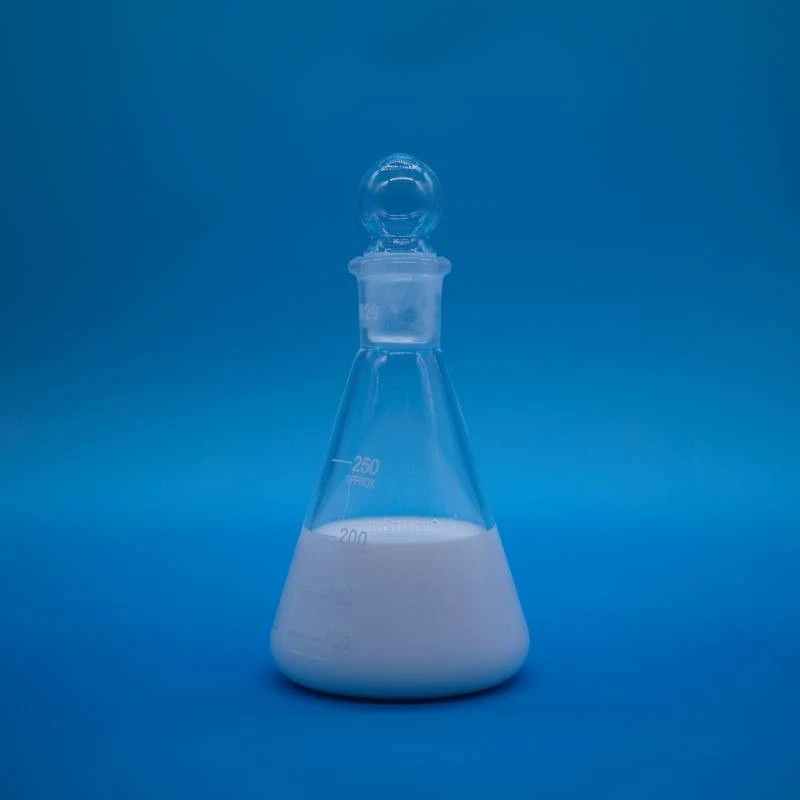
Shandong Peak-tech New Material Co., Ltd. is one of the most reliable manufacturers and suppliers of narrow particle size distribution silica sol in China. With a professional production team, we are able to meet the needs of the majority of our customers. Welcome to buy durable narrow particle size distribution silica sol for sale here from our factory.
Narrow Particle Size Distribution Silica Sol Customization
Peak-tech can review silica-sol projects requiring a controlled nominal particle size and a buyer-defined distribution window. Available source data supports a broad 3–180 nm customization envelope and published size-control values, while the exact distribution specification must be agreed for each project.
| Customization Band | Nominal Particle Range | Published Size Control | SiO₂ Content | Supply Form |
|---|---|---|---|---|
| Fine Nano Control | 3–20 nm | ±1 nm below 20 nm | 20–40 wt% | Aqueous silica sol |
| Intermediate Control | 20–100 nm | ±5 nm above 20 nm | 20–40 wt% | Aqueous silica sol |
| Large-Particle Control | 100–180 nm | ±5 nm above 20 nm | 20–40 wt% | Aqueous silica sol |
The bands describe customization capability rather than standard model codes. Confirm whether the requested control value applies to nominal size, batch target or another reporting basis.
Distribution notice: The published size-control values do not by themselves define a universal particle-size distribution width, D10/D50/D90 ratio, coefficient of variation or polydispersity index. Buyers requiring a "narrow distribution" must provide the required metric, method and acceptance limit.
Translate "Narrow Distribution" into Measurable Limits
Define the Central Value
State whether the target is number-average, intensity-average, volume-average, median or another reported particle diameter.
Choose the Acceptance Metric
Provide D10, D50, D90, span, coefficient of variation, PDI or the specific distribution metric required by the process.
Align Measurement Conditions
Specify the instrument, calculation model, dilution medium, sample preparation and reporting procedure.
Set Lot Acceptance Rules
Agree sampling, repeatability, certificate values, tolerance and change-control requirements before commercial supply.
Information Needed for Distribution-Control Review
Particle distribution must be qualified together with the stabilization system, solids content and actual application response.
- Central particle value: provide the target diameter and its statistical or calculation basis.
- Distribution limits: state required D10, D50, D90, span, PDI, CV or another acceptance metric.
- Analytical method: identify instrument, optical model, dilution, sample preparation and number of repeat measurements.
- Liquid specification: provide SiO₂ content, pH, stabilizing ion, density, viscosity and impurity limits.
- Application conditions: list other formulation components, process water, mixing, temperature and contact conditions.
- Performance criteria: define polishing defects, coating response, pore structure, binding or other relevant output.
- Commercial details: include development quantity, annual demand, packaging and destination country.
Request a Narrow-Distribution Silica Sol Review
Send the nominal size, distribution metric and limits, measurement method, stabilization chemistry, SiO₂ content, pH, application criteria and trial quantity.
Submit Particle Distribution RequirementsPreserve Dispersion Quality During Storage
Packaging Options
Available polyethylene packaging sizes are 25 kg, 250 kg and 1000 kg.
Storage Temperature
Store at 0–40°C and protect from freezing. Freezing can cause irreversible gelation and invalidate particle testing.
Sampling Control
Use a documented sampling and conditioning procedure so test results can be compared consistently between lots.
Container Closure
Keep containers closed to limit evaporation, contamination and concentration changes before analysis.
Narrow Particle Size Distribution Silica Sol Questions
What particle-size customization range is published?
The published customization envelope covers nominal particle sizes from 3 to 180 nm.
What size-control values are published?
Published control is ±1 nm for sizes below 20 nm and ±5 nm for sizes above 20 nm, subject to specification and method confirmation.
Does the published tolerance prove a narrow particle-size distribution?
No. A target-size tolerance does not automatically define distribution width. D10, D50, D90, span, PDI or another required metric must be specified separately.
Why must the analytical method be agreed?
Different instruments, optical models, dilution media and preparation procedures can produce different particle-size and distribution results.
How should samples be stored before particle analysis?
Store them at 0–40°C, prevent freezing and direct sunlight, keep containers closed, and follow a consistent conditioning and sampling procedure.
Hot Tags: narrow particle size distribution silica sol, China narrow particle size distribution silica sol manufacturers, suppliers, factory
Applications Requiring Controlled Particle Distribution
Suitability depends on the agreed distribution metric, measurement method, stabilization chemistry and application performance. "Narrow" must be defined quantitatively for each project.
CMP and Precision Polishing
Control particle distribution to support repeatable removal behavior, surface finish and defect performance in qualified slurries.
Optical Surface Finishing
Evaluate distribution limits against scratch, haze, roughness, cleaning and removal-rate requirements.
Catalyst and Porous Carriers
Assess controlled particles where packing, pore development and silica distribution affect the manufacturing process.
Functional Coatings
Test particle distribution, formulation stability, film formation and surface response with the complete coating chemistry.
Ceramic and Inorganic Materials
Evaluate packing, bonding, drying and microstructure using defined particle and process acceptance criteria.
Research and Custom Formulations
Develop a documented specification using nominal size, distribution metrics, method, batch tolerance and performance tests.


